Showing posts with label League of Gnomes. Show all posts

Wednesday, December 17, 2025

(Gnome Wars) Hawaiian Gnomes Play-Test Rules

 Merry Early Christmas and Happy Hannukah!  It's been asked for repeatedly, so I present to you...  rules for Hawaiians for Gnome Wars!    

It is UNOFFICIAL at this time, but it should give players something to try to break.  

Island Critter, Fire Dancer, Cheiftan    
Plus, there are rules for a new unit in the pipeline! 
War Spearmen

Normal Spearmen    

Stone Axes and Double Stone Axe (NCO)


Hawaiian Gnomes on Google Docs (View Only).   Feel free to submit comments to the blog post, or the post on the Gnome Wars Facebook Group.

Gnome Wars - The Hawaiians
Infantry Movement
Maximum movement for all Gnomes is 12 inches per turn
Gnomes may move 6 inches per turn and fire
Gnomes may move first then fire, or fire first then move.
Firing
WeaponTargest DistanceRoll to Hit# of 6-sided dice
Spear1" to 12"4,5,61
13" to 246

Light Cover: -1 to firing roll
Hard Cover: -2 to firing roll

Hand to Hand
FigureDie for Melee
Chieftan (Officer)
10 sided
Double Stone Axe (NCO)
10 sided
War Spearman8 sided
Spearman6 sided
Stone Axes8 sided
Fire Dancer (Medic)
8 sided
Island Critter8 sided

Fury of the Lono-maka-ihe
Hawaiian Spearmen may move their maximum movement and throw a spear within 2" inches at a target.

Flames of the Islands
At the unit's card, or during the medic phase instead of healing, the Fire Dancer may perform the traditional Flames of the Islands Dance
All gnomes within 12 inches must roll a d6 to see if they are mesmerized by this dance. On a 3+, they are mesmerized and can only move half speed their following turn. No gnome who sees the dance would have the heart to shoot upon the Fire Dancer. The Fire Dancers's own unit is not affected by the dance.

Healing Fire (Medic)
The Fire Dancer has the normal 12 inches of movement each turn.
During the "Medic!" phase at the end of the game turn, they gain an additional 18 inches of movement to attempt to save fallen troops. Attempting to save one figure costs three inches of movement.
Fire Dancers save figures on a 5+ on d8

The Island Critter
The Island Critter may deploy within 24 inches of the unit, hiding in any unoccupied cover. It is unable to be hit in heavy cover
Treat as in heavy cover if in light cover.

Wild Boar Cavalry
Movement allowance for Boar Cavalry is 16 inches per turn. Ignore movement penalties for forests and jungle.

FigureDie for Melee
Cavalry - Charging
10 sided +2
Cavalry - Mounted
10 sided
Unmounted Boar
8 sided +2

Charging:
Roll a d6 and add it to the boar movement. The unit must be formed in either line or 2 ranks to charge. The cannot move into or through buildings, bunkers, or trenches

Random direction - straight line until hits hard obstacle or leaves the board. If it goes into jungle or forest terrain, remove from board.

After completion of medic phase, roll for each fallen cavalry figure. On a 5+ on d8, the rider was killed and the boars are rampaging around.
Unmounted Boars move 16 inches per turn in a straight line, turning randomly when meeting an obstacle. They can NOT jump, and are removed from the board
If they encounter a forest, swamp, on jungle terrain. remove from board

Pineapple Catapult
DistanceDirect Hit
1-123,4,5,6
12-244,5.6
24-365,6
Over 36"6
3-figure team.
3Fire every turn
2Fire every other turn
1Fire every three turns

Direct Fire Weapon, use cannon rules on structures. Direct single hit on troops.

Thursday, December 11, 2025

(Gnome Wars) République Libre des Gnomes du Québec

In the Gnome Wars universe, there is no great French colonization effort in North America.  The aggressive British expansion worldwide was a steady, but brittle crawl across Canada, which forced the independence of O'Canada even before the Americans below.   and by the time of the American Uncivil War, the British were more focused on trying to retain British Columbia than its closer possessions that were truly in name only. 

Quebec had just naturally developed from a collection of French gnomes travelling to avoid war... or just subject to the whims of The Wanderlust. They had set up shop in region, while a host of other gnomish and animal group settled the Maritime Region.  

Largely ignored by the British, the Quebecois simply installed their own French-speaking governor was the British one passed away. It was entirely bloodless. 

The current government of Quebec was established in 1850, after a group of angry Union veteran Leprechauns marched up to Quebec on a whim.  The "Fed-Up-Ians" managed to sack the capital of Montreal (forcing it to move to the city of Quebec).  The new government formed as the Leprechauns marched back, was freer Republic, with a dedication to Liberty and what they considered French culture.  Rights were created and bestowed upon everyone with its borders...

... except the Hated Irish.

In the modern years leading up the German-American War, the Quebecois have formally reconnected with their original French brethren, gladly trading for advanced weapons and uniforms, although it's not surprising to see Canadian equipment at Quebec bases, with everything rewritten in French. 

Thursday, December 4, 2025

(Gnome Wars) Cascadia and the Dual Columbias

It's been a good long while since I've added any Gnomish History to the page.  As a reminder, please consider all this positive fluff to add to your game, but it's certainly unofficial.

And all this is inspired by a lone Union Gnome figure left in a box that needed to be painted... differently.

Cascadia and the Dual Histories: 1836-1910

The 1830's brought expansion to the Pacific Northwest.  At the beginning  of the American Uncivil War, there was a well-timed onset of the Gnomish Wanderlust that brought thousands from American soil across the continent to peace, independence, and prosperity in a land called Columbia.  Around the same time, the British mercantile expansion finally hit the Canadian side of the Pacific, establishing some largely self-supporting trading posts and an independent navy.    As the German-American War drained assets across everyone's empires, the British Columbia politely snubbed their colonial ties from of any remaining tax revenue, and formally gained their own independence from Britain in 1900

  • Columbia:  Its settlers emphasized industry, trade, and exploration, establishing a network of interior river towns and forest outposts. Columbia’s culture reflected a rugged but kind practicality, with towns clustered along rivers and fertile valleys, and its society influenced by a mixture of the Northern and Southern practicalities.  Columbia units prior to 1907 should be Northern American Gnomes with a mixture of Midnight Blue and even Black uniforms.
  • British Columbia: Very quickly, this colony shed it's direct allegiance to, if not the name.  Their interior was largely untouched, focusing only on lumber to fuel the shipbuilding industry, to support the powerful fishing concerns, and continue to grow a sizable navy.  British Columbian units should use British Marines with a darker red for land forces, and a powder blue for naval marines. 
The Columbia Civil War (1905)

Despite peacefully coexisting for decades with the lack of any formal treaties, or even basic acknowledgement of each other, things came to a head in 1905.  Tensions around trade routes, both water and land, resource control (particularly a "Gem Rush" around the border), and long competing visions of the region led to the brief but intense Columbia Civil War.

Lasting only 18 months, it largely consisting of skirmishes along contested areas.  Neither side wanted to levy an army from an unwilling populace, and general malaise and exhaustion quickly led to the both sides meeting and accomplishing far more than a cease fire or a peace treaty.    

The Cascadian Public Safety Force 1907-1910 (present)
Neither side could see any reasons not to benefit from both sides of Greater Columbia.  They formed the Cascadian Confederation to secure their borders with crazy Californians and Mormons to the south, Russian aggression from Alaska, and to maintain a steady influence to avoid native incursions from the east. 

The Cascadian Confederation adopted the more efficient bureaucratic systems of British Columbia to the confederate towns and regions of Columbia.  It's not perfect solution, but neither was fighting nearly identical gnomes in the same area.

Former military units for both sides were reorganized into the Cascadia Public Safety Force (CPSF).  Their domestic visibility was highlighted in bright orange uniforms to promote them as Keepers of the Public Trust & Health.  While not properly documented, it would not be surprising if the CPSF forces in fortresses along the California border also have an all-black Columbia uniform in their lockers, just in case their forces are required to cross the border. 


Monday, June 23, 2025

Proto-German Industrial Tinkering #InternationalGnomeWeek

It has been written that there are only things German gnomes love more than tinkering:  Beer and more beer.  But whenever they put down their steins, and fiddle with a sprocket, their productivity has made Germany the industrialized Gnome war machine it is today.  

The rise of industrialization within the German Empire can be accounted for simply by noting that when they weren't fighting each other the early German territories were tinkering, and when they stopped tinkering, it was obviously time to fight again. 

And the other nations of Gnomekind staring down a German operating new wonder machine hurtling towards them?  That invention started life as a toy for the German's niece.


 Despite the claims of the Ministers of War and of Commerce, the most influential business sector in the modern German is... toys. The tinkerers who designed and implemented new gadgets and gizmos for the toys seem to always scale the innovation larger for war use.  

The steam tank?  Originally a toy parade float powered by beet sap.

Flame auto?  The Rotwurst-Bandit, a kit to put wheels on a red sausage 

Even the first mechanized aircraft were miniatures used in dachshund racing.  

While gnomes have some sort of craft or trade room, to relax and ply their talents, the German version is far more efficient, with kegs built into the process so they don't need to leave the room.    

Two of the Four Immortals of Gnomekind celebrate tinkering.  The Wizard summons living Gnomelings, but also creates the mechanical versions, and, of course, Santa is famous for his numerous inventions.  Both have abhorred the escalation of Germany's industry, and rarely bestows their blessings onto that nation.  The Wizard has been such a foe to the Germans that they written them out of the lore and texts.  

Sunday, June 22, 2025

Rejuvenative Bier and Gnome Alchemy #InternationalGnomeWeek

Gnome society have always maintained a connection to there mystic past, through their use of natural materials, herbalism, apothecary, and burgeoning mad science that has a powerful influence to this day: Gnome Alchemy.  Few disciplines are as feared, misunderstood, and explosively chaotic to this day, 

Most of these concepts are beneficial to gnome is time of peace and war, and very few have to able to ramp up production of these poultices, potions, and tinctures, especially to industrial use. 

Early Gnome Alchemy
According to Gnomish legend, alchemy spawn in the sprawling mushroom growths and caverns of the deep forest,  where early gnome tinkers,  hedge-wizards, and inventors sought to take full advantage of the the fungus among them. Whatever benefits they could derive, it was usually shared with the local community at first, and disseminated across the lands as the Wanderlust took hold of the gnomekind. 

Rejuvenative Bier

Every culture has legends of the their bier-nurses, healers, Geisha tea medics, and doktors, healing, sometimes even raising the fallen with their skill and a sip of a fermented beverage.  When one realizes these same individual couldn't save an unfortunate soul in a tavern brawl and the keg against the wall, it's certain to admit that there are select recipes and additives to allow a gnome to regain their health.  Certain mushrooms are picked for their alchemical reactions and are highly sought after. While certain types of fungus can be poisonous to other creatures, the average gnome has built up generations of tolerance to any toxins.

Alchemy is not magic in its truest sense.  Explosive elixirs have formed the basis for German flamethrowers, as the pressurized gas to discharge the Swiss cheesethrower. Any sort of reactive substance has been relegated to traps and warning.  No one has managed to weaponize these concoctions into grenades or, heavens forbid, mortar.  Amazing things are being done with Mustard Gas and other condiment-based arsenals, put those largely are the product of modern science, with some alchemical roots.  

Gnome Profile: Professor Kettleboom

A hedge herbalist in trade, with no proper schooling, nor commissioned affiliation, this madman is known for riding into battle on a smoke-belching steam-trike while hurling volatile “Fizzy Blasters" at both German and enemy troops.  He is a wild card, also impacting the quality of healing on both sides.  He is infamous for including volatile substances in rejuvenative bier.  

Move:  12"/24" - Unaffected by any musicians.   When activating movement, roll 1d20. On a 1-5, trike stays put.  

Fizzy Blasters: roll to hit target (5+ direct line of sight.  6+ indirect or cover)  then roll damage. 12" range.  3" blast diameter.  4+ to kill with 1", 5+ to kill within 2", 4+ to kill within 3.   Deviation is 4d6 inches in a random directs as the odd device rolls indiscriminately. 

Melee:  d10 if moved during their last turn.  d6 if stationary during their last turn. 
.
Kitbash the steamtrike with what you have available but definitely a German peasant for the base (Nightcafe Flux Schnell)

Sunday, December 22, 2024

(Gnome Wars) Swiss Training Practices

Swiss Gnomes have always been regarded as the quintessential gnome nation.  The many nations citizens and troops outfit themselves in the classic gnome look, well-known among the commoners, but the Swiss have adopted it as their national persona.  

The Swiss army is well known for their miners, their cheese grenadiers, and the rows and rows of blunderbuss to defend the country.  but that is not how they start their training.  They start with giant gnome-sized wooden spoons.


Swiss mandatory service and conscription, while serious, is grounded in their values of discipline, community, and resourcefulness.

The use of giant wooden spoons as the primary training tool for Swiss gnome trainees stems from both practicality and symbolism. Maintaining the proper armory of weapons is difficult in a nation where everyone is armed, so trainees begin with the giant wooden spoon for many practical reason. In the context of military training, these spoons serve as a unique metaphor: before a soldier can wield a weapon of destruction, he must first master the tool of creation.

The giant wooden spoons are heavy and unwieldy for the small gnomes, making them an ideal tool for strength training and endurance building as they drill. They help the recruits develop their coordination, dexterity, and upper body strength without needing to immediately wielding weapons. The trainees must practice complex drills with these spoons, learning balance, timing, and teamwork. The weight distribution of the spoons forces them to develop into the sturdy stocky troops the Swiss are known for.  

In some drills, the spoons are used in mock combat, where the trainees must hone their agility, defense, and deflection rather than brute force, reinforcing defensive strategies. The philosophy behind this training is that gnomes, who are traditionally peaceful creatures, must exhaust every option of defense and strategy before resorting to violence.

Once the trainees have spent a significant amount of time mastering the wooden spoon, they undergo a ritual called "The Stirring of Resolve," where they symbolically stir a massive communal stew, representing the unity and strength of the nation. Following this, they are finally permitted to transition into formal combat training.  

They are also scheduled equally for "Kitchen Patrol" or KP, where their spoon is used for creating daily communal meals.  

Even the progression from spoon to real weapons is gradual.   The spoons are stored properly and trainees move onto wooden blunderbuss and wooden melee weapons and finally then, the traditionally issued weapons.  

Many Swiss that complete training proudly mount their wooden spoon on the kitchen wall, a sign, like the blunderbuss over many hearths, that the gnome is part of something much larger. 

When an elderly Swiss gnome musters out of the militia, many receive a giant wooden fork as a gift from his unit, a play on the saying "Put a fork in him, he's done."  The proud veterans often find a spot adjacent to the spoon in their kitchen.  

And that is why many Swiss gnome grandchildren visit their grandparents and see the giant spoon and fork on the kitchen wall. 

Wednesday, October 23, 2024

(Gnome Wars) Mustard Gas and its Condimentation in Warfare

During the Great War, the use of chemical agents was a horrific evolution of modern warfare.

In Gnome Wars, it's a bit more of an overpowering flavor experience.

Painted by Mike Lung, circa 2012

Mustard Gas can be fired from large mortars and, if the scenario presents itself, off-board artillery.  It should be represented by a large piece of cotton, preferably colored yellow, which can be stretched and molded, and even divided to represent the cloud moving, filling in depressions, and even splitting off.

Shells from on field mortars create a cloud the size of a 3" blast template.  Off-board artillery is more powerful, creating a 5" blast template.  These shells do not cause physical damage like traditional ordinance.  They are ineffective against tanks and fortifications in the traditional sense.  Gas shells do NOT create craters.

Effects:  Mustard gas requires requires each figure within the cloud to flee d8 inches in a random direction. Terrain modifiers still apply.  All figures with the cloud at the end of a round are incapacitated for the remainder of the game and should be removed.   These cloud do not dissipate quickly, so they should remain on the board for the remainder of the game.

Gas clouds obscure line of sight.

Initiative:  Once on the board, all gas clouds should have their own imitative, whether at the same time as the artillery crew that fired, or all clouds collectively as their own entity.

Movement:  The gas cloud can move deceptively quick across the battlefield, but will settle in the lowest spot possible.    Determine a random direction for ALL clouds to move each turn.  Each cloud moves 1d6+6 inches each turn.  Once a cloud finds a lower elevation (downhill, trench) it will pool there and only move the path of least resistance (Ex1:  a gas cloud with a portion in a trench line will remain over the trench unless the wind moves it in a direction that allows it to follow the trench   Ex2: Clouds that fill in, then hover over craters, remain there.)

As I continue to review old correspondence, I found a discussion that each nation's mustard producers are notorious manufacturers of WMD "Weapons of Mass Deliciousness"    The German artillery crew from Mike Lung pictured above is actually from 2012, but I'm not seeing any rules for it.  

Remember, Gnome Wars should be fun and somewhat silly.  Chemical weapons and flamethrowers are graphic parts of war.  Spicy Mustard Gas and Cheesthrowers are devastating but fun.  

So that's it, feel free to model some artillery wagons sponsored by "Gulden's Spicy Brown"

You can also keep the culturally appropriate brands for your army (Loewensenf for Germans, Grey Poupon for the French, and amusingly French's Brown Mustard for the Americans.)

Yellow Mustard has no effect, but are being considered for training rounds for new recruits. 


Wednesday, October 16, 2024

(Gnome Wars) The Great Snail

This past Historicon, my Saturday night Gnome Wars game had an unexpected visitor: a D&D flail snail that a player had purchased at the flea market and I could find no good reason not to allow it on the table.  I made up some rules on the fly, and, as I planned, it proved more of a distraction to players than a game breaker.

Going through some ancient Gnome Wars correspondence with friend of the blog, Award-Winning-GM Mike Lung, I discovered he proposed giant snail rules way back in 2011!  

Great Snail (Wild or Unmanned)

  • Moves Slow:  6" 
  • Moves Randomly unless guided by gnome, guide gnome can also encourage the snail to use its acid spitting attack.
  • Moves over any obstacle without penalty, except salt or fire.
  • Hard to Kill: Only legal 6's with light arms wound the creature.  Heavier weaponry, treat as a tank.
  • Wounds: 4 (Tank results supersede wounds)
  • Weapon:  Acid Spitting  12" artillery, 3" diameter template
  • Leaves a slime trail behind, effect lasts 3 turns.  Roll d8 for each gnome crossing, on a 1-3, the gnome slips and falls. Each roll to get up, the difficulty goes up by 1 (1-4 fails on first attempt, 1-5 on second, and so on.)  Gnomes that can't mathematically succeed are removed from the table. 

Wednesday, October 9, 2024

(Gnome Wars) The Rise of Gnomish Horology and the Red Cap Cults by Mike Lung

Gnome society is an enigma. They generally live a simple bucolic or woodland lifestyle, yet they also are great tinkers and inventors.

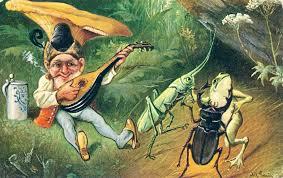
Image result for gnome postcard 

Depictions of a traditional simple gnomish lifestyle

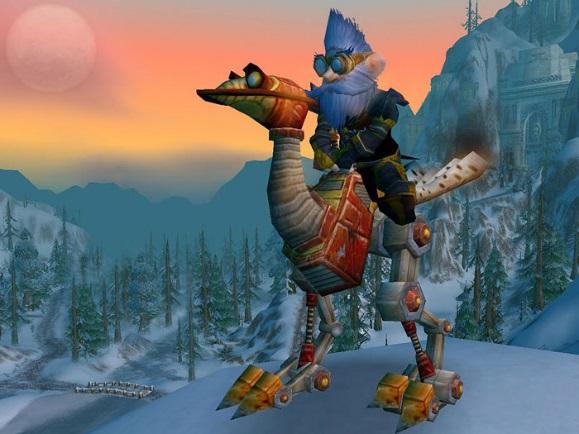
Image result for wow gnome mount 

Tinker gnome riding his invention


Gnomes usually live and dress in very traditional ways. The are often very slow to adopt new ideas or material items. Yet at the same time, they can be very progressive as far as accepting other creatures with different backgrounds and ideas. They generally are willing agents in helping and teaching other species and therefore promoting change within those animal societies. In fact, gnomes are often given credit for teaching the animals how to talk and act in a civilized manner.

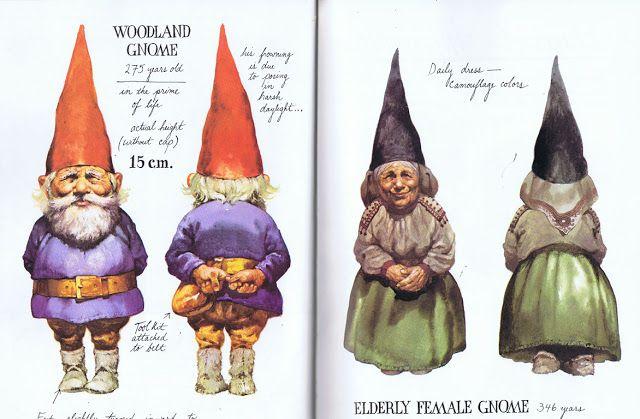
Image result for gnome book 

Traditional gnome dress

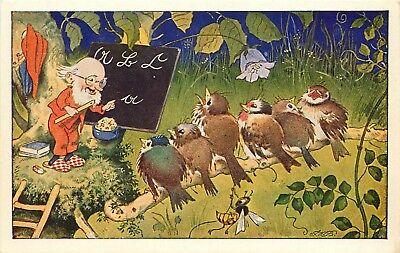
 Image result for gnome postcard teacher

 Gnome teaching animals how to read

The Great Gnome War and the rampant outbreak of the znombie plague decimated the gnome population creating a vacuum for civilized animals to fill. As the war progressed, many animals were called on to serve in the wars. At home, they were also used to support the war effort. This presented an opportunity for animals to take leadership roles in society. Animal doctors, lawyers, clergy, and politicians (positions once held almost exclusively by gnomes) all became much more common in the years proceeding the dual catastrophes. Recently, an animal, Hedgerow Wilson, was elected President.

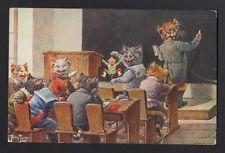
Image result for arthur thiele classroom 

Animal classroom taught be a cat teacher instead of a gnome.

Most gnomes were accepting of this change feeling this was the natural fruition of their own progressive ideas. However, some gnomes rejected this view and still held fast to their insular traditional beliefs. Many of these gnomes believed the world had gone completely crazy, and there was a general feeling that they felt lost with no role in the future. They yearned for a return to the good old prewar days. Others philosophized that the world was like a clock. Like a tooth of a cog, each member of society whether a gnome or an animal had a specific role to play. When everyone did what they were supposed to do, the clock runs smoothly to perfections. However, when the teeth of the cogs are reshaped or changed, or whole cogs are changed, the function of the clock is disrupted. It will no longer function too perfection, or worse yet, if there are too many changes or the changes are too significant, the clock will cease to function at all! It therefore was the duty of all gnomes to make sure that all the teeth and cogs did what they were intended to do. Order and structure hierarchy had to be restored. Those who wish to make or allow these changes to society were an enemy that had to be stopped for the good of all.

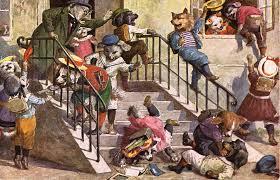
Image result for thiele dog postcard 

Animal run society gotten out of hand.  Order had to be restored under Gnomish leadership


Advocates of the philosophy of the world clock were collectively known as Horologists. This philosophy was highly debated by the citizens. Some openly embracing it, others denouncing it, while most paid not real attention to it as they went about their normal lives. While most of this discussion was theoretically, some secret societies of gnomes did start to form to carry out the mission of restoring the clock. While by mostly lawful means, these secret societies did at times cross the line. Likewise, some animals formed their own secret groups in reaction to advocate their own beliefs. While the government fought to suppress the growth of all of these movements, it was not always successful, and the actions of these groups furthered the cracks in society.


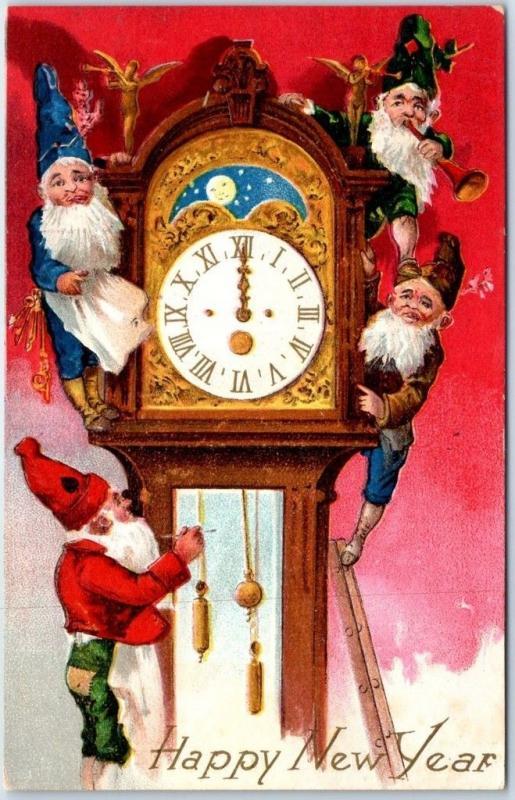
Image result for gnome  postcard clock  

Imaginative depiction of Horologist fixing the World Clock

There were, however, some extreme members of the Horology movement that came to the conclusion that too much change had already occurred. It was impossible to repair the broken cogs of society by normal political or social means. The old clock needed to be discarded, and a new clock needed to be made with a completely new, unbreakable cog system. In other words, these cult-like groups advocated a creation of a new world order. Those members were collectively known as “Red Caps” and would stop at nothing to achieve their purposes. To build their new clock, the consulted long lost or hidden tomes of knowledge. There efforts to obtain these tomes and to advance their goals have no bounds. No animal or progressive gnome was safe from their depredations and their other terrible, deeds.
 
Sample of symbols used various horologist groups. The last two are variations used by Red Cap cultists.


(Notes from the Editor:  Gnomish Historiography is complex, even amongst the keepers of Gnome Lore, The Stout Gnomes.  Much of this article covers the post-Gnome Wars world, which Mike is excellent at with his "Gnömerdammerung" or "Twilight of the Gnomes."  His fantastic modelling and conversions have brought many a smile to the Gnome Wars table, but he's also brought about the znombies, the Cult of Urinitas, and has a lot of material for a far darker gnome world.)

Wednesday, May 22, 2024

Some Notes on Gnomish Day to Day Living

One of the underlying themes of Gnome Wars is the rather sudden industrialization of the German gnomes.  In a basic outline of my history of the German gnomes, industrialized tinkering emerged from the ashes of the Nomepoleonic Wars, which has forced all the nations of the world to reconsider their cottage industry  and craftsman-dominated commerce. 

While the gnome leaders and scholars are trying new things to mount a cannon or machine gun, the average gnome peasant in rural and small village communities are still rather conservative and basic in their lives.    

Homes and Construction

It's not uncommon to find poorer gnome/gnomes on the frontier still living in underground dwellings, hand dug, and expanded over the years.  They are usually climate controlled, although clay and moss-insulated walls do not prevent moisture in certain regions.  

The construction of traditional gnome mushroom homes, and similar building materials, is usually the the sign a gnome or community has risen above abject subsistence poverty.  Mushroom houses are a result of noted Mycologist scholars, in direct competition with certain schools of surviving magic (the myconomancers), providing safe, sustainable, and sturdy construction materials.  

In regards to all gnome homes, even as gnomes construct larger buildings out of wood and stone, the furniture remains predominantly handmade from local wood.  Many pieces featuring intricate carvings and a high level of craftsmanship, although even the fanciest of the German oligarchs homes feature some primitive pieces.  Tables, chairs, and beds are sturdy and built to last for generations.

Agriculture and Gardening

While gnome tinkerers are making advance in war technology, gnome races still practice small-scale, sustainable agriculture. They use hand tools like hoes, spades, and sickles made of wood and metal. Crop rotation and natural fertilizers (compost and manure) are essential to maintaining soil fertility.

From the poorest dirt farmers, or peasants living on a well-run estate of a gnome lord, communal farming is an accepted (and necessary practice).  Farmers work on each others lands, sharing time, equipment, and many times, splitting profits to ensure the base of a successful harvest the following season. 

Almost every gnome household, even most in towns and cities, maintains an herb garden, growing medicinal and culinary herbs such as thyme, sage, and chamomile. These gardens are meticulously tended, often featuring stone pathways and decorative elements.  

Clothing 

Most gnome clothing is still made from natural/local fibers, such as wool and flax.  In most smaller communities, some peasants have enough equipment to spin and weave their fabrics by hand.   While technology has improved in cities and for the war effort, it is still only providing increased production in basic output.  Dying the fabric and all the intricate craftsmanship are still the purview of skilled individuals producing small batches.  Gnomes are skilled weavers and knitters (the French do crochet), creating practical yet beautifully patterned garments that provide warmth and durability.

A note on traditional dress:  While German peasantry is known from their alpine hats and lederhosen, and leprechauns for their full coats and derbies. the traditional frock coat and conical hats are still culturally appropriate dress, although, as gnomes move up the economic ladder, this garb is pushed further and further back in their closets and armoires. (Yes, the Japanese kasa are simply traditional gnome conical hats that have simply evolved to be shorter with wider brims.)

Crafts and Tools

Blacksmithing and woodworking:  Local blacksmiths and woodworkers craft essential tools, from farming implements to kitchen utensils. Blacksmiths forge nails, horseshoes, and tools, while woodworkers carve everything from spoons to intricate window shutters.  While not tinkers by trade and training, they are known to show off tremendous ingenuity to make items customized to the gnome's/community's needs.

Even with the war effort, the modern assembly line still eludes most gnome production.  When thinking of mass production, refer to Eli Whitney more than Henry Ford.  

Transportation

The casual observers sees the steamshps, steam tanks, and trains, and forgets that most gnomes, transportation means using  small, animal-pulled carts. These are often drawn by rabbits, foxes, and smaller domesticated animals, and are used to transport goods to and from the market or fields.

As travel is largely by foot or by cart, most gnome communities maintain a network of extremely narrow footpaths through the forests and fields.  Stone or wooden bridges span creeks and rivers, often featuring carvings and gnome motifs.  No not be surprised by waist high stone walls lining the paths, providing trouble for two carts coming at opposite directions, much less modern troops movements.


Friday, March 11, 2022

(Painting) Statue of St Crastin for Gnome Wars

 The topic of Gnomish Wanderlust has been discussed ad nauseum amongst the Gnomish Intellectuals.   The cycle of exploration, establishment, and partial retraction of the citizenry has expanded Gnomekind across the world.

But what if a Gnome specifically resists the call of the Wanderlust?  You can thank a brave Gnome named Crastin.  

It's unsure whether Crastin was disposed to a certain immunity to the Wanderlust, or he luckily never sucumbed to it, but it was believed to have originated the cult the intentionally fought the urges to remain within Swiss territory. 

The followers of Crastin have been known to prevent gnomes from leaving towns at the height of an exodus, including terroristic acts like blowing up tunnels and bridges.


While most Gnomes are anti-Crastin, the Pro-Crastinators today achieve very little by not expanding their horizons.

I've gotten a wide variety of gnome-related gifts over the years.  A few of them have been gnome gardens, and todays statue is simply a gnome included in the garden set, as well as a flipped over birth bath. 

PROJECT: 350  - 457 (306/151) down  from 460  (305/155).  It boils down to two obvious and important topics in a backlog:  Eight Star Wars Campaign write-ups and an utter lack of gaming.  Slowly getting those rectified, but a year ago this was my great painting push, and I'm afraid it's been hard getting back into the swing of things with this extended miniatures hiatus.

Next: And a new paint scheme for the next Hultr Half-Track for the Gnomish Space Marines.

Saturday, February 26, 2022

Traversing the Winter Landscape.

It's not a winter wonderland here, more of the New York scenes from Day After Tomorrow.  Snow, sleet, freezing rain, a flash thaw, and a flash freeze make for exciting conditions as we traverse far and wide for basketball.  Four games Saturday, followed by AAU tryouts and, if Millie's team does well, a Championship game at 3pm Sunday.  


From a game perspective, especially a game where the Swiss are a major faction, it makes sense to institute some rules for Alpine Troops, but outside of qualifying for the biathlon, what advantages do ski give a unit in a skirmish setting?   I'm not pulling up many options.  Guess I'll need to do further research, perhaps with some chit-based wargames.  

Alpine Dwarfs from Old School Miniatures are the closest thing to Gnomes on Skis, and their sweaters scream more Scandinavian/Canadian than Swiss, but they are very nice figures.

Wednesday, February 16, 2022

(Kickstarter) Goblin Civil War by Sally 4th

Good to see Kickstarter hasn't completely gotten rid of metal miniature campaigns, or zany rules sets.   The Goblin Civil War in 28mm  are a line of figures, terrain, and currently a pdf copy of the rules transporting goblins into the a Spanish Civil War style campaign. 


It is a Sally 4th production, which I'm not against, except I am trying to keep a moratorium on UK shipping (it's just way to expensive and this would tip over my budget).  Here's hoping the follow-up Kickstarter for a printed version of the rules allows for Add-Ons of particular figures I like (especially the refugees).  


Monday, October 4, 2021

(Gnome Wars) Run While the Inn is Closed

Let's kick off my personal year of gaming with some quick, much needed Gnome Wars!  

During the Thirty Beers War, especially the late era of the Meatball Intervention, the numerous armies were weakened from years of brutal fighting.  At its worst, only small warbands roved the countryside, in search of food, bier, and for many, just trouble.  

In certain regions, the Germanian Guard would round up any suspicious gnome who looked like they were not from the region.  They were usually right, as small guerilla bands were infiltrating the countryside.  These bands' only salvation was the Imperial Edict that Inns and Taverns were safe havens for all, doubly so after dark, so long as the entrances were secured.

With Germanian pursuers in all directions, this ragtag band of Free Bier Leaguers had just crossed the river and were near a local pub. 

The Roadside Inn is within distance.  The front building is ruled to have an entrance on each of its four sides.
Unfortunately, a squad of Germanian Regulars were also heading into town, so time was of the essence to rush to the inn, get inside (by force is necessary), and re-secure the door to shelter as many of their comrades as.  
Germanian Regulars

The Free Bier Leaguers
Turn One:  The the lightly armed Free Leaguers, time was critical, so most ran to the Inn.  The few riflemen's shots missed wildly.  
Most of the Germanians stayed off the road, letting a handful of their crack marksmen to fire at the Free Bier League, killing two of their rifles.  

There is certainly a problem.
To make matter much, worse, three of Major Pfiffle's Germanian Lancers had heard the disturbance and had come to investigate.
The Free Leaguers clamored toward the far (and safe) side of inn, readying their picks and axes to knock down the door by any means necessary. 
The Germanian Rifles managed to take out two Leaguers trying desperately to reach the front door. 
As Piers the miner beat in the side door with his axe, a flagon of bier stuck him in the head, and Catharina the barmaid blocked the doorway with menace in her eyes. 
"Zee Inn iz Clozed!"
The last remaining Free League rifleman took down one of the rabbit cavalry, only to be taken out my a Germanian rifle before he reached the door.  
With Catharina blockng the door, only two of the Free Leaguers managed to squeeze past her while she was distracted by another gnome.  
As the Germanians rounded the back, the far side door was bolstered and fortified, with two new overnight tenants.  Two survivors was not much, but far better than other groups that had been eluding the Guard.

This was a quick scenario using Alternative Armies' scenario "Run While the Pub is Closed."  I thoroughly enjoyed the concept (including the random appearance of the cavalry, and the Biermaid Guard, both of whom occurred at the worst popular times possible.

...and any excuse to break out my personal gnomish history justify a  scenario is a hoot!